
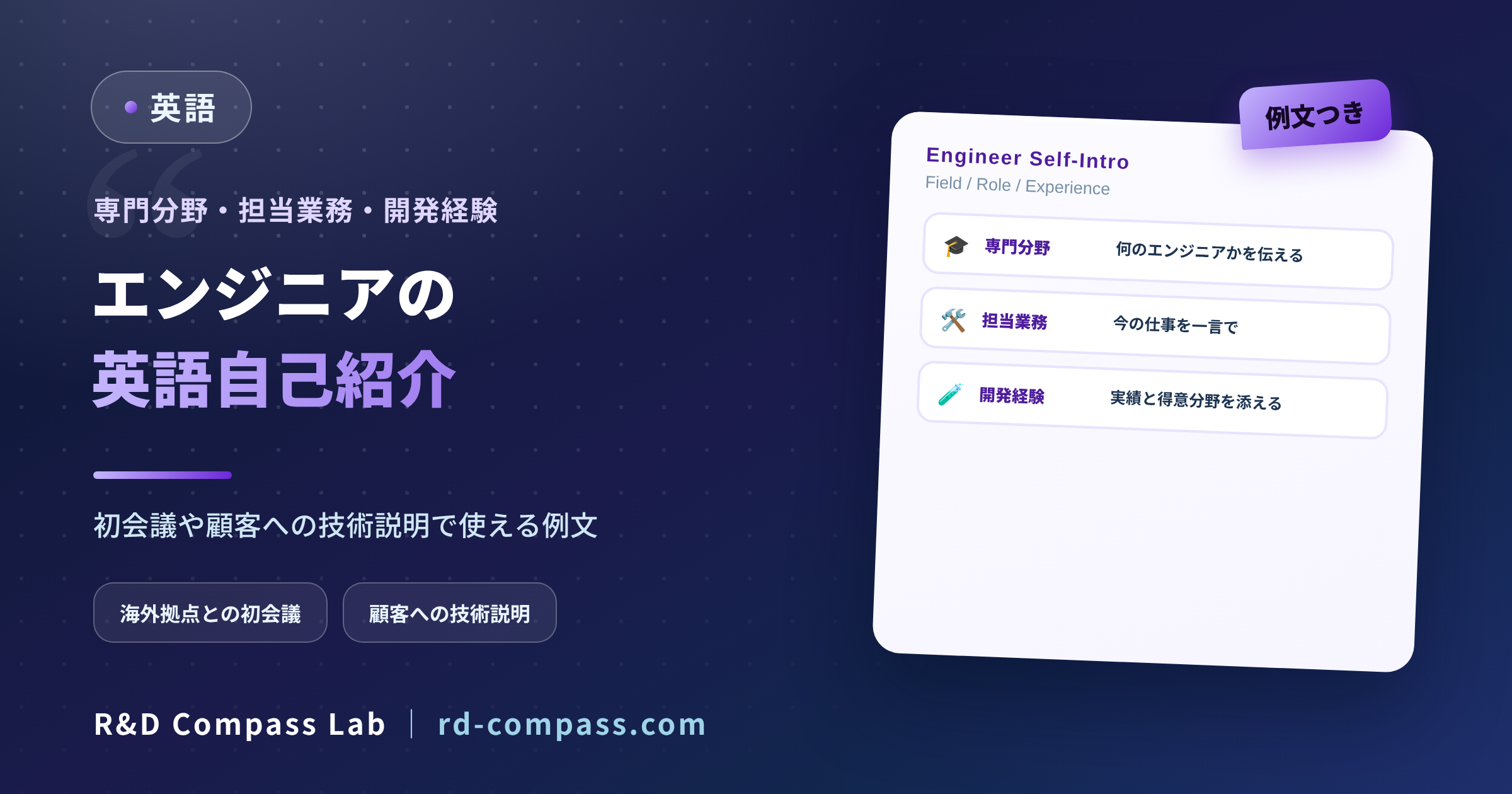
海外拠点との初会議、顧客への技術説明、工場訪問、共同研究の打ち合わせ。エンジニアの自己紹介では、名前と所属に加えて「何を担当し、今日の議論にどう関わるか」を伝えると、相手が質問や相談をしやすくなります。
この記事では、研究開発・設計・製造・品質の担当者が、自分の仕事に置き換えて使える表現を紹介します。日本語で要点を確認した後、後半の英語だけの練習パートにも挑戦できます。
この記事でわかること
- 名前・所属・担当・経験・面談目的をつなげる基本の型
- 30秒・1分・2分を目安にした自己紹介の例文
- 研究開発・設計・製造・品質・管理職の職種別表現
- 自己紹介の後に会話をつなぐ質問と返答
- 訪問前の英文メールと、声に出して使う練習方法
以下の人物・企業・経験・実績は学習用の架空例です。実際に使う際は、ご自身の担当・実績に合わせて変更してください。
基本の型長さ別の例文職種別の表現会話例英文メールEnglish practice
1. エンジニアの英語自己紹介は「担当」と「目的」を軸にする
基本は、名前・所属、担当業務、専門や経験、今回の目的の順番です。短い場面では経験を省き、担当と目的を優先します。
伝えること
英語の型
意味
名前・所属
I’m Yuki Tanaka from ABC Materials.
ABC Materialsの田中優希です。
職種
I work as a materials engineer.
材料エンジニアとして働いています。
担当業務
I work on polymer formulation and testing.
ポリマーの配合設計と評価に取り組んでいます。
専門・経験
My background is in analytical chemistry.
専門的な背景は分析化学です。
今回の目的
I’m here to discuss the next round of sample testing.
次回のサンプル評価について話し合うために参加しました。
初対面では、社内の部署名だけを説明するより、相手が理解できる業務を一つ添えると具体的になります。たとえば「先端技術開発第三グループ」を長く訳す代わりに、次のように言えます。
I’m part of our R&D team. I develop coatings for electronic components.
「研究開発チームに所属し、電子部品向けのコーティング材料を開発しています」という説明です。会社全体の事業説明は、相手が会社を知らない場合に短く足せば十分です。
2. 30秒・1分・2分を目安にした英語の自己紹介
時間は話す速さや間の取り方で変わります。まず声に出して計り、予定時間に合うよう調整してください。短い版を基本に、必要な情報を足すと扱いやすくなります。
30秒程度:初回のオンライン会議
Hi, I’m Yuki Tanaka from ABC Materials. I work in R&D, focusing on polymer formulation and testing. For this project, I’ll be your main contact for sample evaluation. I’m looking forward to learning more about your requirements and discussing how we can work together.日本語訳と使い方
ABC Materialsの田中優希です。研究開発部門で、ポリマーの配合設計と評価を担当しています。このプロジェクトでは、サンプル評価の主な窓口を務めます。御社の要求を詳しく伺い、どのように協力できるか話し合うことを楽しみにしています。
your main contact for …は、相手が何を相談すればよいかを示す便利な表現です。
1分程度:顧客との技術打ち合わせ
Hello, I’m Yuki Tanaka from ABC Materials. I’m a materials engineer in our R&D department, where I develop polymer formulations for industrial adhesives. I have eight years of experience in formulation development and performance testing. In my current role, I work closely with our manufacturing and quality teams to move promising formulations from the lab to pilot production. For this project, I’ll coordinate sample preparation and help interpret the test results. Today, I’d like to understand your operating conditions and agree on the key performance targets for the next evaluation. Could you also tell us a little about your role in the project?日本語訳と使い方
ABC Materialsの田中優希です。研究開発部門の材料エンジニアとして、工業用接着剤のポリマー配合を開発しています。配合開発と性能評価に8年の経験があります。現在は製造・品質部門と連携し、有望な配合をラボからパイロット生産へ移しています。このプロジェクトでは、サンプル作製の調整と評価結果の解釈を担当します。本日は使用条件を理解し、次の評価で重視する性能目標を合意したいと考えています。皆さんのプロジェクトでの役割も教えていただけますか。
専門、部門間連携、今回の担当、会議の目的まで含めた例です。最後の質問は、自分が進行する場面で使います。司会者がいる場合は、次の人への進行を任せましょう。
2分程度:海外研究機関への訪問
Thank you for having us today. I’m Yuki Tanaka, and I lead a small materials development team at ABC Materials. My background is in polymer chemistry, and I’ve spent the past ten years working on formulations for industrial applications.
Our team focuses on improving durability while keeping processing conditions practical for manufacturing. We combine experimental testing with data analysis to understand how composition and processing affect performance. In a recent internal project, we used this approach to narrow down candidate formulations before moving to pilot trials.
I’m particularly interested in your work on accelerated aging and the relationship between laboratory tests and performance in service. We would like to explore whether our materials and your evaluation methods could support a joint study.
During today’s visit, I hope to learn about your testing capabilities, discuss a possible initial study, and identify the information each side would need before moving forward. I’d also be happy to explain our current evaluation workflow and the technical questions we’re trying to answer.日本語訳と使い方
本日はお招きいただきありがとうございます。ABC Materialsで小規模な材料開発チームを率いる田中優希です。専門は高分子化学で、過去10年間、産業用途の配合開発に携わってきました。
チームでは、製造で実用的な加工条件を維持しながら、耐久性を高めることに注力しています。実験評価とデータ分析を組み合わせ、組成と加工条件が性能に与える影響を調べています。最近の社内プロジェクトでは、パイロット試験へ進む前に、この方法で候補配合を絞り込みました。
特に、皆さんの促進劣化試験と、ラボ試験・実使用性能の関係に関する研究に関心があります。当社の材料と皆さんの評価方法を組み合わせた共同研究の可能性を探りたいと考えています。
本日は評価設備や技術を伺い、初期検討の内容と、次に進む前に双方が必要とする情報を確認したいと思います。当社の評価フローや、解決したい技術課題もご説明できます。
長い自己紹介では、経歴の羅列よりも「現在の技術課題」と「相手との接点」に時間を使うと、次の議論につながります。
3. 研究開発・設計・製造・品質・管理職の職種別表現
場面・職種
そのまま使える英語
伝えている内容
研究開発
I develop coating materials for automotive applications.
自動車用途のコーティング材料を開発する
分析・評価
I specialize in surface analysis and failure investigation.
表面分析と不具合調査が専門
機械設計
I design mechanical components for inspection equipment.
検査装置の機械部品を設計する
制御・ソフトウェア
I develop control software for production equipment.
生産設備の制御ソフトウェアを開発する
生産技術
I work on process development and production line improvements.
工程開発と生産ライン改善に取り組む
設備保全
I’m responsible for equipment maintenance and troubleshooting.
設備保全とトラブル対応を担当する
品質管理
I monitor product quality and investigate process variations.
製品品質を監視し、工程変動を調べる
品質保証
I handle customer quality inquiries and coordinate corrective actions.
顧客の品質問い合わせと是正措置の調整を行う
データ分析
I use data analysis and machine learning to support materials development.
データ分析と機械学習で材料開発を支援する
チームリーダー
I lead a team of six engineers working on process optimization.
工程最適化を担う6人のチームを率いる
職名の訳は会社や国で異なるため、公式の英語職名があればそれを使い、担当業務の一文を添えます。品質管理・品質保証の担当範囲も、実際の役割に合わせて表現してください。
4. work on・be responsible for・specialize inの使い分け
表現
使い方
例文
work on
現在取り組むテーマや課題
I work on improving coating uniformity.
be responsible for
自分が責任を持つ担当範囲
I’m responsible for the final inspection.
specialize in
専門としている分野
I specialize in thermal analysis.
have experience in
経験のある領域
I have experience in pilot-scale production.
lead / manage
チームを率いる/業務や資源を管理する
I lead our testing team and manage the project schedule.
specialize inは専門性を強く示します。少し経験がある分野なら、I have some experience in …とすると、経験の程度まで伝えられます。
成果を伝える場合は、自分の関与を明確にします。たとえばOur team reduced the testing time by 20%. I was responsible for redesigning the test procedure.なら、「チームで試験時間を20%短縮し、自分は試験手順の再設計を担当した」と説明できます。数値を使う際は、比較条件と社外に共有できる範囲を確認しましょう。
5. 自己紹介の後に会話を続ける英語
相手に何を尋ねるかまで準備すると、自己紹介が一方向で終わりにくくなります。
You: Hi, I’m Yuki. I work on process development at ABC Materials. I’ll be coordinating the pilot trials for this project.
Partner: Nice to meet you. I’m Alex, the production engineer at our local plant.
You: Nice to meet you too. Which part of the production line do you support?
Partner: Mainly the mixing and coating stages.
You: That’s helpful to know. We’ll probably work closely together when we review the trial conditions.
会話の要点を日本語で確認
自分がパイロット試験を調整することを伝えた後、相手がどの工程を担当するかを質問しています。混合・塗工工程の担当と分かり、試験条件の確認で連携する接点を示す流れです。
目的
質問・返答
相手の役割を知る
What is your role in this project?
今の課題を知る
What technical challenges is your team focusing on?
連携する相手を確認する
Who would be the best person to contact about the test conditions?
自分の担当外だと伝える
My colleague handles that area. I can put you in touch with her.
相手の話をもう少し聞く
Could you tell me a little more about that?
6. 訪問前に送る自己紹介の英文メール
メールでは、会う目的と自分の役割を冒頭に置き、相手への依頼を具体的にします。次の例は、すでに日程が決まっている技術訪問の事前連絡です。
Subject: Introduction ahead of our technical meeting on November 12
Dear Dr. Morgan,
My name is Yuki Tanaka, and I’m a materials engineer at ABC Materials. I’ll be joining our technical meeting on November 12.
I work on polymer formulation and performance testing. For this project, I’ll coordinate sample preparation and the evaluation plan.
During the meeting, I’d like to discuss the test conditions and the performance targets for the initial samples. If there are any specific requirements you would like us to review in advance, please let me know.
I’m looking forward to meeting you and learning more about your team’s work.
Best regards,
Yuki Tanaka
Materials Engineer, R&D
ABC Materials
日本語訳と調整のポイント
Morgan先生、ABC Materialsの材料エンジニア、田中優希です。11月12日の技術打ち合わせに参加します。ポリマー配合と性能評価を担当しており、このプロジェクトではサンプル作製と評価計画を調整します。
会議では初回サンプルの試験条件と性能目標について相談したいと考えています。事前に確認してほしい特定の要求があればお知らせください。お会いして、皆さんの取り組みを伺うことを楽しみにしています。
Dr.は相手の博士号などを確認して使います。名前や呼び方は相手の署名・案内に合わせて調整してください。件名の日付は実際の日程に置き換えます。
7. 日本語から直訳すると曖昧になりやすい表現
伝えたいこと
選びたい表現
ポイント
開発を担当しています
I work on developing heat-resistant coatings.
何の開発かを添える
研究をしています
I conduct research on membrane materials.
研究活動は通常、不可算のresearchを使う
経験が8年あります
I have eight years of experience in process development.
期間と業務領域を組み合わせる
専門は化学です
My background is in chemistry.
学問的な背景を説明できる。学生時代の専攻ならI majored in chemistry.も使える
よろしくお願いします
I’m looking forward to working with you.
これから一緒に働く場面に合う結び
I’m in charge of …も担当を説明する自然な表現です。業務への関わりを広く示すならI work on …、担当責任をはっきり示すならI’m responsible for …と、伝えたい範囲に合わせて選べます。
8. English practice: Introduce yourself with a clear purpose
ここからは英語だけで進める練習パートです。まず訳を見ずに読み、声に出して取り組んでください。
Step 1: Build your introduction
Use the prompts below. Choose one specific task that helps your listener understand your work.
- My name is [name], and I work at [company].
- I work as a [role] in our [department] team.
- I work on [specific task or technical topic].
- For this project, I’ll be responsible for [your contribution].
- Today, I’d like to [meeting goal].
Step 2: Make it specific
Compare these two sentences:
- I work in engineering.
- I develop inspection methods for electronic components.
The second sentence gives your listener a clearer picture of your work. Now rewrite your own sentence. Include a product, process, method, or technical problem.
Step 3: Try three situations
- A first project meeting: Explain your role and what your partners can contact you about.
- A factory visit: Explain which process you support and what you want to learn.
- A research visit: Explain your technical interests and one possible connection with the host team’s work.
Step 4: Answer follow-up questions
Say your answers aloud. One or two sentences for each question is enough to start.
- What are you working on at the moment?
- How does your team work with manufacturing?
- What would you like to achieve in this meeting?
Step 5: Review and improve
Record a short introduction. Listen once for clarity and once for content. Can a new colleague understand your role? Have you explained why you are joining the meeting? Remove details that do not help the conversation.
Quick practice
Complete each sentence with a suitable expression.
- I work ___ improving the reliability of our inspection process.
- I’m responsible ___ coordinating the pilot trials.
- My background is ___ mechanical engineering.
- I’m looking forward to ___ with your team. (work / working)
Suggested answers
- on
- for
- in
- working
Try saying each complete sentence without looking at the page.
9. よくある質問
技術用語をたくさん入れた方が専門性を伝えられますか?
相手の専門に合わせます。別分野の相手には、用途や解決したい課題から説明し、必要に応じて測定法や材料名を足します。同分野の専門家なら、具体的な手法や技術課題を最初から示せます。
英語に自信がないことを最初に伝える必要はありますか?
担当業務から話し始めて構いません。聞き取れない部分があれば、Could you say that again a little more slowly?など、必要な助けを具体的に頼むと会話を進められます。
部署の責任者はどう自己紹介すればよいですか?
公式の職名に加えて、I lead our R&D team.やI oversee process development across three sites.のように責任範囲を説明します。人数・拠点数などは、相手に役立つ場合に添えてください。
丸暗記と、その場で話す練習のどちらを優先しますか?
まず短い基本版を用意し、担当・目的・質問を場面ごとに差し替える練習がおすすめです。同じ文章を速く読むことに加えて、初めて会う相手にも意味が伝わる内容かを確認しましょう。
10. 自分用の30秒版を作ってみよう
最初の一歩は、名前・所属、具体的な担当、今回の役割を3~4文にまとめることです。研究開発なら評価対象、製造なら担当工程、品質なら確認する事項を一つ入れてみてください。最後に相手への質問を一つ用意すれば、自己紹介から技術的な会話へ移りやすくなります。
本記事の例文・会話・演習は学習用に作成したオリジナルです。